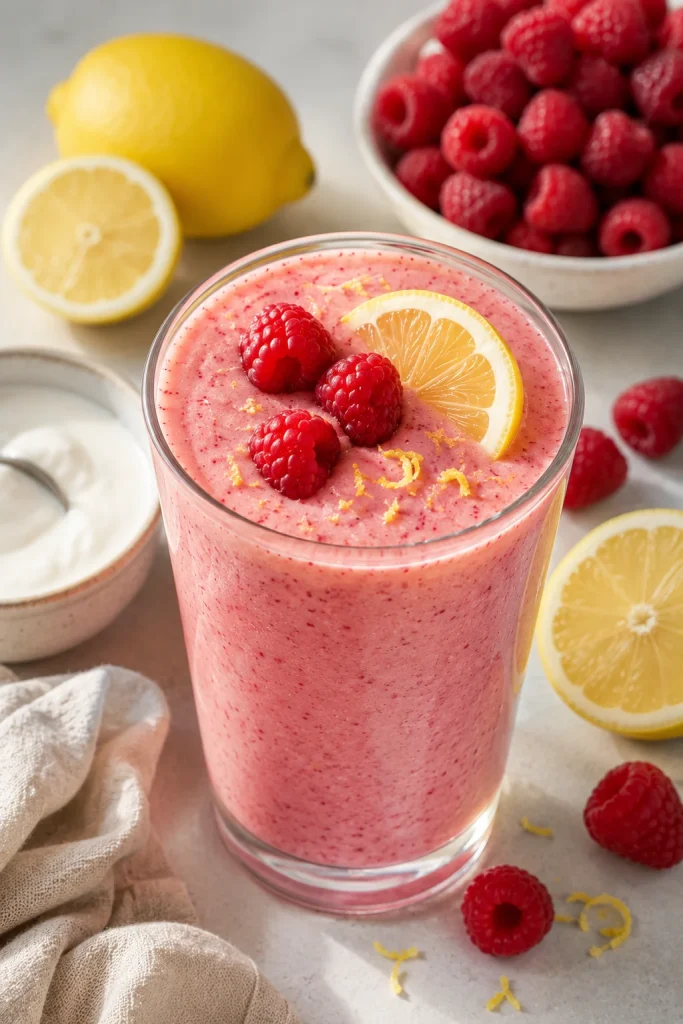
Some smoothies taste homemade in the best sense — honest, familiar, comforting. And some smoothies taste like something you’d pay premium money for at a café counter. This one belongs to the second category. The color alone — a deep, vivid rose-pink — puts it in different territory. Pour it into a clean glass, set it in front of someone who’s never seen it, and watch their expression before they’ve taken a sip.
The flavor, when it arrives, matches what the color promised. Raspberries are more complex than most smoothie fruits — tart, slightly floral, with a depth that strawberries don’t quite have and blueberries approach from a different direction. On their own they can veer toward sharp. But paired with lemon zest and Greek yogurt, they find a kind of harmony that makes the whole drink feel genuinely sophisticated.
The lemon zest is the detail that makes this recipe. Not the juice — though juice is in here too — but the zest, grated directly into the blender. The zest of a lemon contains the volatile aromatic oils that live in the skin, and those oils have a bright, floral, intensely citrusy character that extracted juice alone doesn’t capture. Add it to a raspberry smoothie and what you get is something that tastes dimensional in a way that simple fruit-yogurt blends usually don’t.
This is also, with 15 grams of protein per serving, one of the more nutritionally substantial recipes in this collection. Greek yogurt is doing serious work here — not just as a texture agent, but as a meaningful source of protein that extends the smoothie’s staying power significantly beyond what the raspberries and honey alone would provide.
Make this one when you want to feel like you went somewhere nice for breakfast. You didn’t go anywhere. You made it yourself in five minutes. But it tastes like you did.
Ingredients
(Makes 1 generous serving)
- 1 cup frozen raspberries
- ¾ cup plain Greek yogurt — full-fat or 2%
- ½ cup whole milk or unsweetened oat milk
- Zest of 1 lemon — grated with a microplane, done before anything else
- 1 tablespoon fresh lemon juice
- 1 tablespoon honey
- 4–5 ice cubes
How to Make It
Step 1 — Zest the lemon first, directly into the blender.
This is the most important technique instruction in the entire recipe. Zesting the lemon directly into the blender — rather than onto a cutting board and then into the blender — captures every last bit of the aromatic oils as they’re released. Those oils are volatile and begin to dissipate almost immediately upon exposure to air. Zesting directly into the container keeps them contained until blending begins. Use a microplane for the finest, most flavorful zest.
Step 2 — Add the milk and Greek yogurt.
These go in next, directly over the zest. The liquid and yogurt will begin to take on the lemon aroma immediately — you can smell it as you add them. This is correct.
Step 3 — Add frozen raspberries, lemon juice, and honey.
The raspberries go in on top. Because they’re frozen, they act as a natural weight that helps push everything down toward the blades. The lemon juice goes in last because it’s acidic — in yogurt-based blends, adding acid too early can occasionally cause slight curdling at room temperature, though this isn’t a problem once blending begins.
Step 4 — Blend on high for 60 seconds.
Raspberries have seeds that are more resilient than they look — they need a full minute of high-speed blending to break down as completely as possible. At 60 seconds, you’ll still have some seed texture remaining, which is natural and not unpleasant. If you want a completely seedless result, see the tip below.
Step 5 — Add ice and pulse.
Add the ice cubes and pulse 5–6 times to chill without over-diluting. The smoothie is already cold from the frozen raspberries; the ice just brings it to the ideal serving temperature.
Step 6 — Optional: strain for a silkier result.
Pour the smoothie through a fine mesh sieve or strainer to remove the remaining raspberry seeds. This adds about 60 seconds to the process but produces a noticeably more refined, café-quality texture.
Flavor Profile
Taste: The raspberry arrives first — bright, tart, complex in a way that simpler smoothie fruits aren’t. The lemon zest creates a citrus brilliance that makes the raspberry taste more vibrant rather than competing with it. The honey provides sweetness without weight. The Greek yogurt brings a clean, pleasant tanginess that ties everything together. On the finish, the lemon lingers — floral and bright. This is a flavor that tastes awake.
Texture: Medium-thick with slight seed texture unless strained. Creamy from the Greek yogurt without being dense. It moves more freely than the avocado or banana-oat recipes — somewhere between a refined smoothie and a pourable frozen dessert.
Aroma: Fresh lemon zest hits you first and most strongly — floral, intensely citrusy, unmistakable. The raspberry is underneath it, sweet and berry-forward. Together they smell like the beginning of a very good morning.
Chef’s Tips
Zesting matters more than juicing in this recipe. The lemon juice adds acidity, which is important. The lemon zest adds aroma and a completely different dimension of citrus flavor. If you have to choose between the two — say, you’ve squeezed your lemon and forgotten to zest it first — the juice can be increased to compensate for sweetness, but nothing compensates for missing zest. Always zest before juicing.
Invest in a microplane. A microplane grater produces fine, dry, intensely flavored zest — exactly what you want in a blended drink. The grater on the side of a box grater works, but it produces coarser strips that don’t blend as completely. A microplane is one of the more useful and affordable kitchen tools you can own, and this recipe is as good a reason as any to get one if you don’t have one.
For a seedless smoothie, strain it. Pour the finished smoothie through a fine mesh strainer over a bowl or directly into the glass. Use the back of a spoon to press the smoothie through, leaving the seeds behind. This takes about 60 seconds and removes perhaps 10% of the volume, but the texture improvement is significant — particularly if you’re serving this to someone who tends to dislike seeded drinks.
Full-fat Greek yogurt only. The fat content of the yogurt is what creates the creamy, smooth texture and the satisfying body of this smoothie. Non-fat Greek yogurt is thinner and more sour, and it produces a noticeably less pleasant result. This is not a smoothie that benefits from low-fat substitution.
Taste before pouring. Raspberries vary quite a bit in tartness depending on the brand and the particular batch. Some frozen raspberries are intensely tart; others are much milder. Taste the smoothie after blending and decide whether it needs a little more honey — sometimes it does, sometimes the raspberries are sweet enough that the recipe doesn’t need any.
Variations Worth Trying
Raspberry Peach Lemon Smoothie
Replace half the frozen raspberries (½ cup) with frozen peach slices. The peach softens the tartness of the raspberries considerably, creating a rounder, more mellow flavor that’s less assertively sour. The color shifts from deep rose to a warm peachy-pink. This is the variation for people who like raspberry but prefer their smoothies on the gentler side.
Strawberry Lemon Yogurt Smoothie
Replace the raspberries entirely with frozen strawberries. The strawberry version is sweeter, less complex, and more widely appealing — it’s the crowd-pleasing option when you’re making this for someone who might find raspberries too sharp. The color becomes a slightly lighter, more classic smoothie-pink. The lemon zest remains important and should not be reduced.
Lemon Poppy Seed Smoothie
Add 1 teaspoon of poppy seeds to the blender with the other ingredients. They won’t fully blend, leaving small dark specks throughout the smoothie that add a very subtle, slightly nutty crunch. This variation tastes like a lemon poppy seed muffin that decided to become a drink — which is a specific and excellent flavor combination.
Raspberry Lemon Smoothie Bowl
Reduce the milk to ¼ cup. Blend until the mixture is very thick — almost like soft-serve ice cream. Pour into a wide bowl and top with granola, fresh raspberries, thin lemon slices, honey, and a sprig of mint. This version is too thick to drink but is genuinely beautiful as a smoothie bowl, and the raspberry-lemon combination works exceptionally well with the crunch of granola.
Nutrition Information
(Per serving — approximate values)
| Nutrient | Amount |
|---|---|
| Calories | 270 kcal |
| Total Fat | 4g |
| Saturated Fat | 2g |
| Protein | 15g |
| Total Carbohydrates | 38g |
| Dietary Fiber | 6g |
| Natural Sugars | 24g |
| Added Sugars | 8g |
| Sodium | 110mg |
| Potassium | 530mg |
| Calcium | 340mg |
| Vitamin C | 42mg |
| Vitamin B12 | 0.8mcg |
| Phosphorus | 290mg |
| Probiotics | Present (from live-culture yogurt) |
| Ellagic Acid | Present (from raspberries) |
On the protein-to-calorie ratio: At 270 calories and 15g of protein, this smoothie has one of the best protein-per-calorie ratios of any recipe in this collection. It’s genuinely filling without being calorie-dense, which makes it a useful option for people who want a substantial breakfast without a high calorie count.
On Greek Yogurt and Why It Belongs Here
Greek yogurt does more in this smoothie than just add protein. It provides a tangy backbone that makes the raspberry and lemon flavors more interesting — it adds contrast that prevents the drink from tipping into cloying sweetness. It contributes a creamy texture that neither milk nor juice alone can produce. And if it’s made with live cultures, it provides probiotic bacteria that support digestive health.
The tanginess of Greek yogurt is also, specifically, why the lemon works so well in this recipe. Both ingredients have natural acidity. Rather than competing, they amplify each other — the yogurt tang makes the lemon brighter, and the lemon makes the yogurt tang taste more complex and less one-dimensional. This is flavor synergy in the simplest possible sense.
There’s also something to be said about the restraint of this smoothie. It doesn’t have oats or avocado or nut butter. It doesn’t have frozen banana as a base. It’s simply excellent fruit, excellent yogurt, and the brilliant addition of lemon zest. Sometimes the most refined version of something is also the simplest.
The Smoothie Worth Making on a Friday
This is a recipe for when you want breakfast to feel like a small reward. Not just fuel, not just nutrition — but something that genuinely gives you pleasure before the day has really started. The color, the aroma, the bright-tart-creamy flavor — these are things that make a five-minute morning routine feel considered and intentional.
Make it on a Friday. Make it when you have a cup of good coffee alongside it and five minutes to sit down before things start moving. Or make it at 7 AM on a Tuesday when you’re in a hurry and just need something real. It works both ways. That’s what a genuinely good recipe does.
Nutrition values are estimates and may vary depending on specific ingredients and brands used.