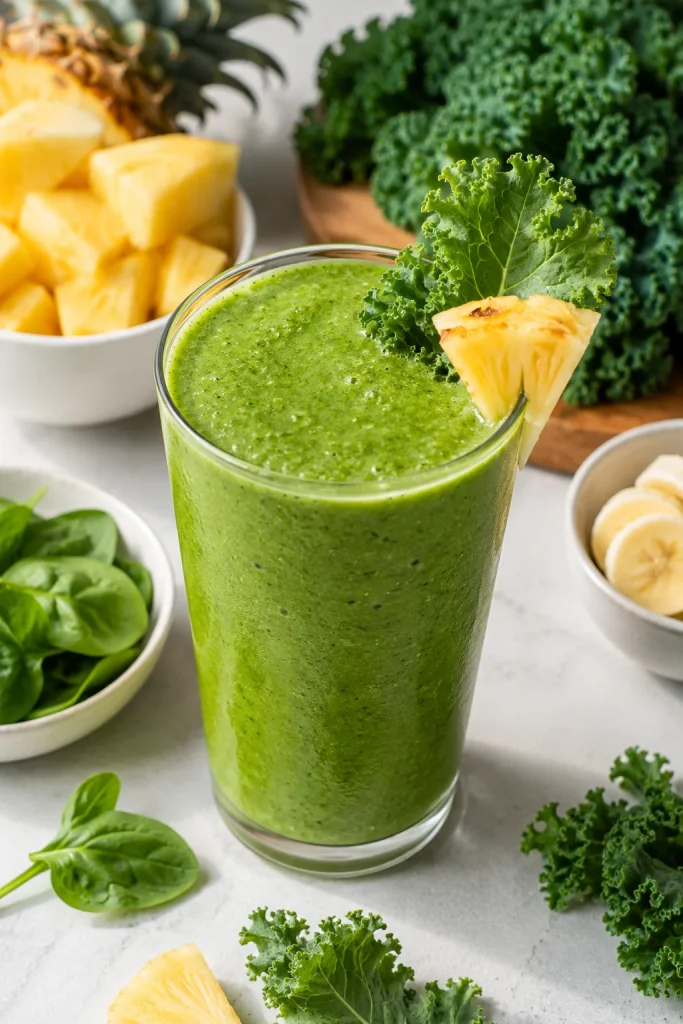
Kale has a credibility problem in smoothies. It’s the ingredient that makes people feel virtuous for putting it in, then slightly punished for actually drinking it. The bitterness of kale blended poorly — with the wrong fruits, in the wrong proportions, without the right technique — produces something that tastes like an expensive mistake. People make it once, pour it down the sink, and decide that green smoothies are just not for them.
This recipe is built specifically to correct that experience.
The combination of frozen pineapple, banana, and coconut water is one of the more effective flavor frameworks for managing kale’s assertive character. Pineapple is high in natural acids and sweetness — it has enough flavor intensity to hold its own against kale without getting overshadowed. Banana adds body, natural sweetness, and creaminess that softens kale’s rough edges. Coconut water is light, mildly sweet, and hydrating — it carries the other flavors without adding heaviness or dairy.
The technique matters as much as the ingredients. Kale doesn’t blend the same way spinach does. It has tougher cell walls, stronger flavor compounds, and a fibrous structure that requires a specific approach to break down properly. The key is pre-blending the kale with the liquid before any frozen fruit goes in — giving it 20–30 seconds of blending time alone before introducing the cold ingredients that slow everything down. This single step is the difference between a green smoothie with green flecks and bitterness, and one that’s completely smooth and genuinely tropical-tasting.
Done right, this is the green smoothie you’ll actually make again. The color is a deep, vibrant green that looks impressive. The flavor is tropical-forward with kale existing only as a faint, pleasant earthiness in the background. The squeeze of lime at the end ties everything together with a brightness that makes the whole drink feel alive.
This is what a kale smoothie is supposed to be.
Ingredients
(Makes 1 generous serving)
- 1 cup frozen pineapple chunks
- 1 frozen banana
- 1 cup curly kale — stems completely removed, roughly torn
- 1 cup coconut water
- Juice of half a lime
- 4–5 ice cubes
How to Make It
Step 1 — Remove every stem from the kale.
This is not optional. Kale stems are significantly more bitter and more fibrous than the leaves, and they don’t blend smooth regardless of how long you run the blender. Pull each leaf away from its stem by running your fingers along the stem from bottom to tip. Discard the stems entirely. Use only the leafy part.
Step 2 — Kale and coconut water into the blender first.
Add the coconut water and torn kale leaves to the blender and close the lid. Blend on medium-high for 20–30 seconds. You’re breaking down the kale completely before the frozen fruit goes in. This step is the heart of the technique — kale needs warmer liquid and more time than frozen fruit allows. Pre-blending gives it both.
Step 3 — Open the blender and check.
At this point, the kale-coconut water mixture should be uniform and green with no visible large leaf pieces. If you still see chunks, blend for another 15 seconds. Only move forward when the kale is fully integrated.
Step 4 — Add frozen pineapple, banana, and lime juice.
Add the frozen fruit and lime juice to the already-blended kale mixture.
Step 5 — Blend on high for 60–90 seconds.
The frozen fruit will slow the blending process initially — this is normal. After 30 seconds, the blender will find its rhythm and start pulling everything smoothly. Give it the full 90 seconds for the most uniform result.
Step 6 — Add ice and pulse.
Add ice cubes and pulse 5–6 times. Drink immediately.
Flavor Profile
Taste: Pineapple dominates — bright, tart, intensely tropical. Banana comes second as a creamy, sweet undercurrent that softens the pineapple’s sharpness and adds body. The lime appears as a citrus finish that makes everything feel more vibrant and complete. The kale, after proper blending, contributes a faint earthy undertone that most tasters would describe as “green” rather than “bitter” — it reads as a background note rather than a foreground flavor. Coconut water adds a mild, slightly tropical sweetness without dairy creaminess.
Texture: Smooth and medium-light. This is one of the more drinkable smoothies in the collection — it moves freely, doesn’t require a wide straw, and goes down easily. It doesn’t have the density of the avocado or banana-oat recipes, which makes it particularly good for warm mornings when you want hydration alongside nutrition.
Aroma: Tropical and fresh. Pineapple leads the aroma completely — sweet, slightly tangy, unmistakably tropical. The lime adds a citrus brightness underneath. The kale doesn’t announce itself aromatically once it’s properly blended.
Chef’s Tips
Baby kale is significantly easier to work with. If your blender is standard-powered rather than high-speed, substitute baby kale for curly kale in the same quantity. Baby kale has smaller, more tender leaves with thinner cell walls that break down much more easily. The flavor is slightly milder, which is also a benefit if you’re new to green smoothies. The pre-blending step is still important with baby kale, but the results are more consistently smooth even in less powerful blenders.
Stem removal is the single most important prep step. The bitterness that gives kale its negative reputation in smoothies comes primarily from the stems. Remove them entirely and the kale flavor becomes manageable and even pleasant. This takes about 60 seconds for a full cup of kale and makes an enormous difference in the finished result.
Use real coconut water, not flavored varieties. Coconut water should contain one ingredient: coconut water. Flavored coconut water, or “coconut water beverage” with added flavors and sweeteners, will push the smoothie in a direction that conflicts with the natural fruit flavors. The mild, clean sweetness of pure coconut water is exactly what this recipe is designed around.
The lime is essential, not optional. A squeeze of lime juice does two things: it cuts through the tropical sweetness to prevent the smoothie from tasting cloying, and it brightens the kale flavor in a way that makes it taste more green-and-fresh rather than green-and-earthy. Don’t skip it. If you’re out of lime, a squeeze of lemon works as a substitute.
Don’t blend beyond what the kale needs. Once the kale is fully integrated and the frozen fruit has broken down — at around the 90-second mark — stop blending. Continuing to run the blender past this point can actually increase the bitterness of kale by releasing more of its aromatic compounds from the now-broken cell walls. Blend until smooth, then stop.
Variations Worth Trying
Kale Mango Green Smoothie
Replace the frozen pineapple with frozen mango chunks in the same quantity. The mango version is softer and less acidic — the tropical sweetness is there but without pineapple’s sharpness. The color deepens slightly toward a more olive-green shade. This is the right variation for people who find pineapple’s tartness too intense first thing in the morning.
Kale Apple Ginger Smoothie
Add half a green apple (cored, roughly chopped) and a ¼-inch piece of fresh ginger (grated) after the kale pre-blending step. The green apple adds a bright, tart apple flavor that complements kale beautifully, and the ginger creates a spicy warmth that makes the whole thing feel energizing rather than just nutritious. This is the most complex-tasting variation and works particularly well with the coconut water base.
Spinach Version for Beginners
Replace the kale with 1 cup of packed baby spinach. Skip the pre-blending step entirely — spinach doesn’t need it. Blend everything together from the start. The result is milder, lighter in color (bright green rather than deep forest green), and completely without bitterness. This is the variation to make for someone who is new to green smoothies and not yet sure they want to taste the green.
Kale Coconut Protein Smoothie
Add 1 scoop of vanilla protein powder and replace half the coconut water with light canned coconut milk. This creates a richer, creamier, more substantial smoothie that pushes the protein content from 4g to approximately 25g per serving. The coconut milk adds a richness that the coconut water version doesn’t have, making this variation genuinely filling rather than hydrating and light.
Nutrition Information
(Per serving — approximate values)
| Nutrient | Amount |
|---|---|
| Calories | 260 kcal |
| Total Fat | 1g |
| Saturated Fat | 0g |
| Protein | 4g |
| Total Carbohydrates | 60g |
| Dietary Fiber | 5g |
| Natural Sugars | 42g |
| Added Sugars | 0g |
| Sodium | 110mg |
| Potassium | 840mg |
| Vitamin C | 80mg |
| Vitamin K | 145mcg |
| Vitamin A | 3,200 IU |
| Folate | 52mcg |
| Calcium | 120mg |
| Iron | 1.5mg |
| Manganese | 1.4mg |
| Magnesium | 55mg |
On the vitamin K content: Kale is one of the most concentrated dietary sources of vitamin K1, which plays a role in blood clotting and bone metabolism. One cup of raw kale provides more than 100% of the daily recommended intake for most adults. People who take blood-thinning medications (warfarin/Coumadin) should be aware of their vitamin K intake and speak with their healthcare provider about consistency in consuming high-vitamin-K foods.
On the zero added sugars: This smoothie contains no added sweeteners of any kind. Every gram of sweetness comes from the pineapple, banana, and coconut water — whole, unprocessed food sources.
Why Kale Belongs in Your Morning
Kale is nutritionally remarkable. Per calorie, it delivers more vitamins A, C, and K than almost any other common food. It contains calcium, iron, and folate. It has fiber. It has compounds called glucosinolates that have been studied extensively for their role in supporting cellular health. And it adds all of this to a smoothie without adding significant calories, fat, or sugar.
The reason most people don’t eat more kale is not that they don’t know it’s good for them. It’s that they don’t know how to make it taste good. This recipe solves that problem. The technique — pre-blending the kale with liquid before adding anything else — is the key that unlocks kale’s potential as a smoothie ingredient and removes the obstacle that’s kept most people from using it.
What you’re left with, when you get the technique right, is a breakfast that’s one of the most nutrient-dense drinks you can make in five minutes at home. Deep green, bright-tasting, hydrating, naturally sweet, and good enough that you’ll look forward to making it again.
That’s all a green smoothie has to be. This one gets it right.
Nutrition values are estimates and may vary depending on specific ingredients and brands used.