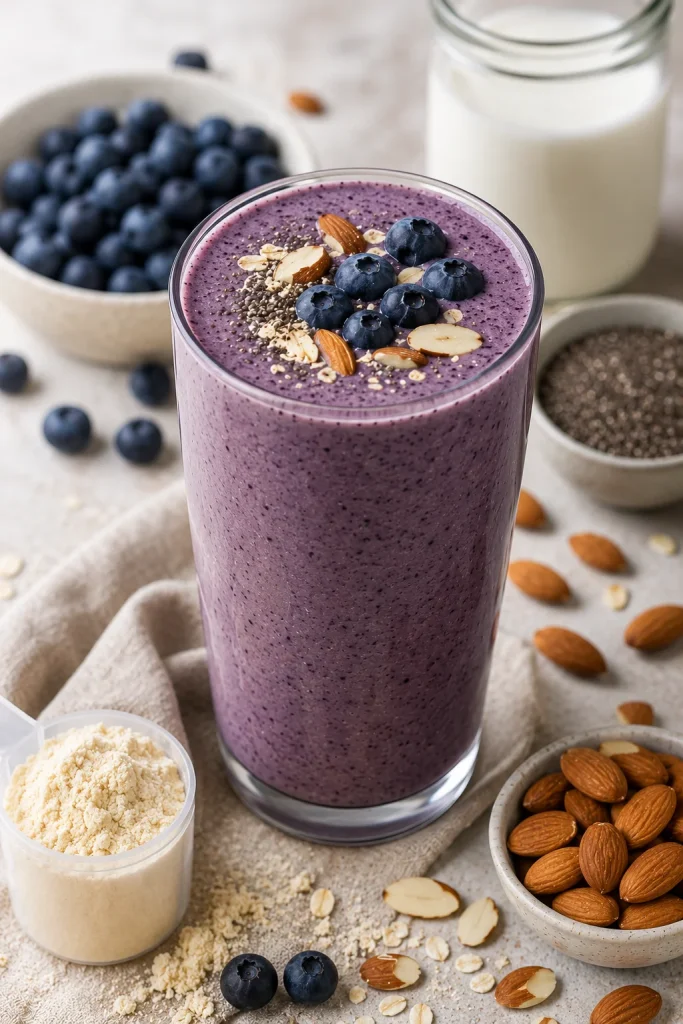
There’s a version of “healthy breakfast smoothie” that’s become a bit of a cliché — pale pink, slightly sweet, gone in four minutes, forgotten by nine. This is not that version. This smoothie is a deep, dramatic purple. It’s thick enough that a spoon would stand up in it. It has 16 grams of protein before you even consider adding a protein powder. And it tastes — genuinely, not just technically — good.
The combination of wild blueberries, almond butter, and full-fat Greek yogurt is one of those pairings that feels like it was always meant to exist. Blueberries are complex in a way that most smoothie fruits aren’t — slightly tart, slightly floral, with a depth of flavor that survives blending and chilling and still comes through clearly in the finished drink. Almond butter adds a rich nuttiness that deepens everything. Greek yogurt brings a tangy creaminess and the protein content that separates this from a juice.
If you’ve been making smoothies for a while and you’ve been disappointed by ones that taste fine but don’t hold you for more than an hour, this is the recipe worth paying attention to. The protein and fat here create a breakfast that digests slowly and steadily — the kind that lets you reach 11 AM without a single thought about food.
And then there’s the color. You pour this into a glass and it looks like something from a restaurant menu. Deep indigo-purple, thick, almost luminous. That’s not a small thing. The way food looks affects how it tastes — we all know this, even if we don’t always say it — and a smoothie this beautiful is one you look forward to making again.
Ingredients
(Makes 1 generous serving)
- 1 cup frozen blueberries (wild blueberries, if you can find them)
- ½ cup plain Greek yogurt — full-fat or 2%
- 2 tablespoons almond butter, smooth and natural
- 1 cup unsweetened almond milk
- 1 tablespoon pure maple syrup
- ¼ teaspoon almond extract — optional, but genuinely worth it
- 4–5 ice cubes
How to Make It
Step 1 — Liquid and yogurt first.
Add the almond milk and Greek yogurt to the blender. Starting with liquids and soft ingredients creates a smoother vortex that pulls everything else down and toward the blades efficiently. It also prevents the almond butter from getting stuck at the bottom before the liquid gets to it.
Step 2 — Add the remaining ingredients.
Add the frozen blueberries, almond butter, maple syrup, and almond extract if using. The almond extract is a small quantity with a large effect — a quarter teaspoon is precisely the right amount. It adds a distinctive marzipan-adjacent note that amplifies the almond butter beautifully. Half a teaspoon is too much; the flavor becomes perfume-like and overwhelming. Stay at a quarter teaspoon.
Step 3 — Blend on high for 60 seconds.
Give it the full minute. Frozen blueberries have thick skins that take longer to break down than softer fruits, and the yogurt needs time to fully integrate with the almond milk. At 60 seconds, the texture goes from blended-but-slightly-chunky to genuinely velvety.
Step 4 — Add ice and pulse.
Drop in the ice cubes and pulse 4–5 times — enough to chill and slightly thicken the smoothie without diluting it. Full blending of the ice after an already well-blended smoothie can make it watery; the pulse method keeps it thick.
Step 5 — Taste, then pour.
Before pouring, taste. The almond extract in particular can be uneven — sometimes the bottle is older and more concentrated, sometimes fresher and lighter. Tasting lets you catch this before it’s in the glass.
Flavor Profile
Taste: Blueberry leads — deep, slightly tart, genuinely complex in a way that simpler smoothie fruits aren’t. The almond butter comes second as a rich, creamy, slightly sweet undercurrent. The maple syrup adds just enough sweetness to round the whole thing out without making it cloying. The almond extract, if used, adds a faint marzipan quality that elevates the whole blend noticeably. The Greek yogurt shows up on the finish as a pleasant tang.
Texture: Thick and velvety — one of the denser smoothies in this collection. This is a drink you eat as much as you drink. Satisfying in a physical, substantial way.
Aroma: Sweet blueberry with a hint of almond — particularly pronounced if the almond extract is included. It smells like something from a patisserie window, which is an excellent way to start a morning.
Chef’s Tips
Wild blueberries are worth seeking out. Cultivated blueberries — the large, plump ones sold fresh at most grocery stores — have a milder, sweeter flavor that blends into a fairly generic berry taste. Wild blueberries are smaller, more intensely flavored, and more tart. They’re usually sold frozen (look for the Wyman’s brand, which is widely distributed) and they produce a significantly more complex, more interesting smoothie. If all you have is cultivated blueberries, they work fine — but if you’ve never tried the wild variety in a smoothie, the difference is worth experiencing.
The almond extract is optional but excellent. Skip it for a clean, straightforward blueberry-almond smoothie. Add it for something that tastes more layered and distinctive. The quarter teaspoon is a hard limit — exceed it and the flavor becomes overwhelming in a way that’s very difficult to correct.
Don’t use non-fat Greek yogurt here. The fat in full-fat or 2% Greek yogurt is what creates the velvety, creamy texture that makes this smoothie exceptional. Non-fat yogurt produces a thinner, slightly more tart result that doesn’t have the same richness. This is one of the cases where low-fat substitution genuinely costs you something worth keeping.
For higher protein: Add 1 scoop of vanilla protein powder before blending. This pushes the protein content from 16g to approximately 36–38g per serving — making this one of the more protein-dense breakfast options available in smoothie form. The protein powder integrates invisibly and doesn’t change the flavor profile meaningfully.
Make it thicker with less liquid. If you prefer smoothie-bowl consistency rather than a drinkable smoothie, reduce the almond milk to ½ cup. The result is thick enough to eat with a spoon and works beautifully topped with granola, fresh blueberries, and a drizzle of almond butter.
Variations Worth Trying
Blueberry Cashew Smoothie
Replace the almond butter with cashew butter in the same quantity. Cashew butter has a milder, slightly sweeter, more buttery flavor than almond butter — it creates a gentler, creamier result that lets the blueberry flavor come through even more clearly. It’s the right variation for days when you want the fruit to be the star rather than the nut butter.
Blueberry Lemon Protein Blend
Add the juice of half a lemon and the finely grated zest of a quarter lemon before blending. The lemon brightens everything — it makes the blueberry taste more vibrant, the yogurt tang more present, and the whole drink feel more energizing. This is a particularly good variation for warm summer mornings.
Mixed Berry Almond Smoothie
Replace half the blueberries with frozen blackberries. Blackberries are more tart and earthy than blueberries, and the combination creates a depth and complexity that a single-berry smoothie doesn’t quite reach. The color gets even darker — closer to a deep wine-purple — and the flavor takes on a genuine sophistication.
Blueberry Almond Smoothie Bowl
Reduce the almond milk to ½ cup. Blend until very thick. Pour into a wide bowl and top with granola, fresh blueberries, sliced banana, a drizzle of almond butter, and a sprinkle of hemp seeds. This turns the recipe into a meal that feels substantial enough for a weekend morning when you have an extra five minutes to make it look good.
Nutrition Information
(Per serving — approximate values)
| Nutrient | Amount |
|---|---|
| Calories | 340 kcal |
| Total Fat | 15g |
| Saturated Fat | 1.5g |
| Protein | 16g |
| Total Carbohydrates | 38g |
| Dietary Fiber | 5g |
| Natural Sugars | 22g |
| Added Sugars | 4g |
| Sodium | 190mg |
| Potassium | 560mg |
| Calcium | 380mg |
| Vitamin C | 14mg |
| Vitamin K | 28mcg |
| Manganese | 1.2mg |
| Vitamin E | 5mg |
| Iron | 1.5mg |
On the antioxidant content: Blueberries — particularly wild varieties — are among the most antioxidant-dense fruits available. The purple pigment (anthocyanins) responsible for the smoothie’s striking color is also what gives blueberries much of their nutritional character. These compounds are heat-sensitive, which means a cold blended smoothie preserves them more effectively than a cooked preparation would.
Why the Protein Content Here Actually Matters
Sixteen grams of protein from a smoothie is not a trivial amount — it’s comparable to two and a half large eggs, or about a third of the daily protein intake most active adults aim for. And unlike protein from a powder or supplement, the protein here comes from whole food sources: Greek yogurt and almond butter, both of which also contribute fat, calcium, and additional micronutrients.
The practical effect of this protein level is that this smoothie metabolizes differently from most. It takes longer for your body to process, produces a longer-lasting fullness signal, and avoids the blood sugar spike-and-crash pattern that lower-protein, higher-sugar breakfast drinks often create. For people who exercise in the morning, this makes it a particularly suitable post-workout option — the protein supports muscle recovery, the carbohydrates from the blueberries and maple syrup replenish glycogen, and the fat provides sustained energy for the rest of the morning.
The Smoothie You’ll Actually Keep Making
The test of any recipe is whether it survives contact with a real morning — with limited time, with a blender that needs to be rinsed before you can use it, with the general friction of getting ready for a day that’s already started demanding things from you. This smoothie passes that test. It takes five minutes. The ingredients keep in your freezer and pantry indefinitely. The result is something that looks impressive, tastes excellent, and keeps you going until lunch without requiring any further thought about food.
Make it on a Monday when you’re not sure about the week. You’ll be glad you have something this reliable in your corner.
Nutrition values are estimates and may vary depending on specific ingredients and brands used.